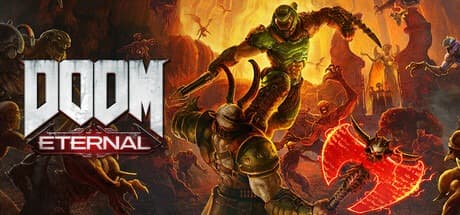
Learn the rhythm before increasing the difficulty
DOOM Eternal turns combat into a sequence of decisions made while moving. You are the Slayer facing a demonic invasion, but staying alive depends on more than firing continuously at the nearest target. Health, armour and ammunition interact with specific tools. Understanding that relationship makes an arena easier to read than treating every low resource meter as a reason to retreat indefinitely.
The campaign moves through designed levels rather than a large open-world map. Encounters, traversal sections and optional discoveries shape the route. It suits players who enjoy practising a demanding sequence and improving their execution. The violence is explicit and stylised, with a pace that rewards attention to several threats at once.
Recover supplies through the combat system
Glory Kills on staggered enemies provide health, the chainsaw replenishes ammunition when used on a suitable target, and Flame Belch can generate armour from burning enemies as they take damage. These tools have conditions and resource limits; they are not interchangeable buttons that solve every shortage. Notice which resource is low and choose the corresponding action before the situation becomes desperate.
Small enemies can remain useful sources of supplies during a larger fight. Spending every available tool immediately may leave fewer options when you actually need them. Read the arena as a changing set of threats and opportunities. A short recovery action can be part of an aggressive route rather than a pause outside the fight.
Move toward a purpose
Dashing, jumping and using the level's traversal features help avoid becoming trapped. Movement is most useful when you know where it leads: another height level, a supply opportunity or a clearer line of fire. Repeating the same circle without checking the next obstruction can eventually carry you into the very group you were trying to escape.
Watch for cooldowns and available movement options before committing to a gap. Outside combat, take a moment to identify the intended traversal sequence. Missing a jump because the next surface was not understood is a different problem from lacking the speed to react during an arena battle. The game asks you to learn both situations.
Give each weapon a job
Weapon modifications change how a gun behaves and create alternatives for different targets. Practise a small set deliberately, then add others as their uses become clear. Switching weapons because it suits a target or conserves a resource is more effective than choosing only by visual impact. The upgrade menus offer improvements, but those benefits still depend on actually using the corresponding tool.
For a more character-led campaign with quieter infiltration and conversation between intense firefights, Wolfenstein: The New Order offers a different rhythm. DOOM Eternal places much more emphasis on a continuous combat routine and rapid changes of position. Choosing between them is as much about pacing as their shared first-person perspective.
Check the PC package and the content you own
The Windows release requires a 64-bit environment and suitable graphics hardware. Publisher listings identify 8 GB of RAM and substantial installation storage; the current Steam listing gives 80 GB. Graphics presets and features such as ray tracing have different requirements, so ordinary minimum specifications do not imply every advanced option is available or practical.
The Ancient Gods campaigns are additional content, not automatically part of every base-game purchase. Confirm the edition before planning that continuation. Begin with a difficulty and configuration that let you understand the combat feedback, then increase the challenge once movement, recovery and weapon selection form a routine you can control.