
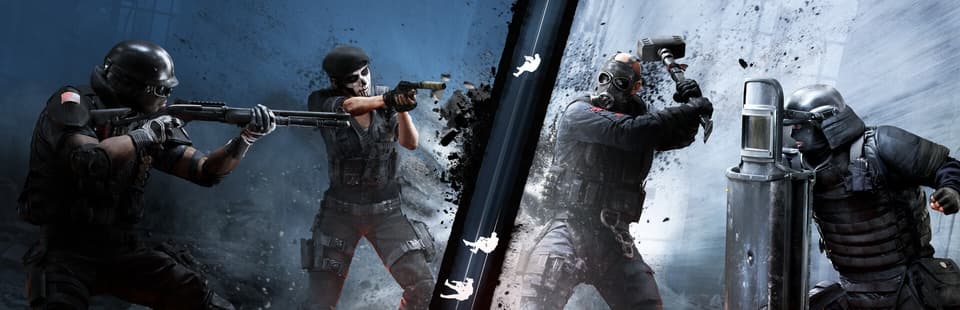
Rainbow Six Siege is an online shooter in which understanding a building can matter as much as aiming quickly. Two teams of five alternate between attack and defence, using operators with specialised equipment. A room that appeared safe can change when a wall is breached or an opponent opens a route from another floor. Ubisoft Montreal’s game rewards reading those changes and sharing useful information with the team.
Attack with information, defend with a plan
Attackers use observation drones to locate threats, inspect routes and prepare an approach. A drone is useful because it can answer a specific question before a player commits to entering. Knowing that an area was clear several moments ago is not the same as knowing it is clear now. Update the team with information that helps the next decision instead of assuming the first view remains accurate throughout the round.
Defenders reinforce surfaces, place barricades and deploy gadgets to influence movement. Cameras and other surveillance tools help reveal an approach before it reaches the objective. Preparation is not simply a matter of placing every available item: think about which route the equipment protects and how it affects teammates. An obstacle that blocks the enemy can also change the way your own group moves between positions.
Destruction changes the map
Walls, floors and available entry points make vertical play important. Rappelling can create a different approach to a window, while an opening above or below a room can change its defensive value. This is why learning the layout includes more than memorising a path from the spawn to a doorway. Consider which spaces connect and which surfaces separate them.
Operators provide distinct tools for these situations, rather than acting only as interchangeable character appearances. Choose a role you can explain to your teammates and learn how its gadget fits the objective. A consistent contribution is more useful than selecting an unfamiliar operator solely because another player describes it as powerful. Balance changes also mean that old advice about a specific gadget may need checking.
Players familiar with Counter-Strike 2 will recognise the importance of team communication and carefully chosen engagements. Siege adds operator abilities and destructible surroundings to that decision-making. It is therefore worth comparing the whole round structure rather than expecting another version of the same weapon-focused contest.
What free access actually includes
The current free-access offer covers Quick Match and Unranked with a selection of operators. Ranked playlists, Siege Cup and further content require the appropriate paid access, with progression and eligibility rules also applying. Reaching a level does not by itself make every premium feature free. Similarly, obtaining a cosmetic item does not automatically unlock an entire operator catalogue.
Older Siege X announcements mention the six-versus-six Dual Front mode. Ubisoft ended that playlist at the start of Year 11 Season 2, so it should not be treated as an available permanent mode today. The core of the current game remains its tactical five-versus-five competition. This distinction matters when an older video or download description promises a different format.
Windows setup and playing with friends
The published minimum lists 64-bit Windows 10 or 11, Ryzen 3 3100 or Core i3-8100, 8 GB of RAM and 65 GB of available storage. Graphics options include GeForce GTX 1650 4 GB, Radeon RX 5500 XT 4 GB or Intel Arc A380 6 GB, with DirectX 12. A persistent internet connection and Ubisoft account are required; this is not an offline story campaign.
PC and console users can form mixed groups, but a squad containing a PC player uses the PC matchmaking pool. A PC user does not enter the console-only pool. Check the intended group and mode before arranging a session, especially when friends have different access tiers.
Current updates and competitive requirements
The reviewed official mid-season update is Y11S3.2 within Operation Split Fire. Its changes adjust operators and fix issues, so there is no reliable universal loadout that can be copied forever without revisiting its purpose. For the PC Legend Division, Ubisoft specifies additional R6 ShieldGuard security requirements, including TPM 2.0, Secure Boot and Memory Integrity. Those particular competitive conditions should not be confused with a claim that every newcomer must change firmware settings merely to try Quick Match.