
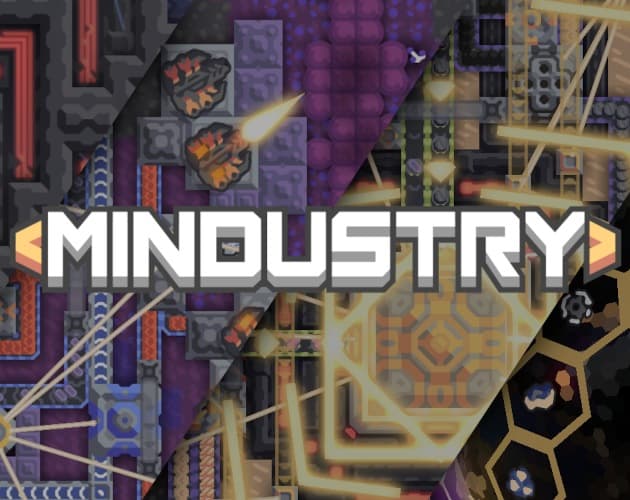
A defence game where the factory matters
Mindustry asks you to solve two problems at the same time: produce what the base needs and keep that production alive. Mining equipment, conveyors, processors and weapons share the same landscape. A wall of turrets is not much help if the ammunition line stops several screens away. The interesting decisions happen between the front line and the industrial network supporting it.
The presentation is compact and viewed from above, but the systems reward careful observation. Follow a resource from its deposit to its destination and you can usually understand why something has stalled. This makes the game appealing to players who enjoy diagnosing a layout rather than simply buying a stronger unit whenever difficulty increases.
Build the first supply chain before expanding
For an opening base, establish a dependable route from a useful deposit to the core. Leave room around that route for junctions and future branches. Building tightly against every available tile can make a small early factory awkward to improve when new materials or machines become necessary. A slightly longer route with space for changes can be easier to maintain.
Then connect a modest defensive position to its required supply. Watch the actual movement of items rather than assuming a connected-looking belt works as intended. A reversed section, blocked junction or shared line can prevent resources reaching the destination. Fixing that bottleneck may improve survival more than placing another weapon that competes for the same insufficient supply.
Treat production and defence as one system
Different facilities introduce demands for power, liquids and intermediate materials. Expanding one part of the base can expose a weakness elsewhere: a new production chain may consume resources previously reserved for construction or ammunition. Inspect the whole route when throughput falls. Increasing mining capacity will not solve every problem if the limitation lies in transport or processing.
Terrain also shapes defensive planning. A narrow approach can concentrate attacks, while a spread-out layout needs several protected routes. Keep an eye on infrastructure behind the weapons, because losing a conveyor or power connection can disable a position indirectly. The goal is a resilient working system, not a screenshot filled with impressive buildings.
Pick a mode that matches the session
Campaign progression gives industrial problems a longer context, while custom maps and sandbox-style experimentation let you try layouts without committing to the same progression. The map editor extends that experimentation further. Multiplayer can divide responsibilities between construction, supply and combat, but shared resources still require coordination. Agree on the immediate goal so players do not compete over the same limited stockpile.
For a strategy game centred more on vehicle design and battlefield manoeuvres, Warzone 2100 shifts the emphasis. If you want time to consider every decision without real-time pressure, Unciv offers a turn-based alternative. Mindustry's distinctive appeal is the connection between automated production and the fight happening around it.
Start small on an unfamiliar computer
The official Windows distribution is available as a 64-bit package. Performance depends on the scale of the simulation as well as the computer, so a compact visual style is not a guarantee that every enormous map will run smoothly. Begin with a modest scenario before adding large networks, many units or extensive modifications.
Keep a copy of important saves before changing versions or a mod setup. In multiplayer, check that participants use compatible builds and required content. Once the basic flow of materials is understandable, expansion becomes a deliberate design exercise rather than a sequence of emergency repairs.